Engineered for high stability and low-vibration operation, the Mirle AI Humanoid Robot is designed for semiconductor and high-precision manufacturing environments.
Combining mobility with dual-arm manipulation capabilities, it is suited for long-duration operation in clean, precise, and high-reliability factory settings. Compared to legged robots, its wheeled mobile base effectively reduces motion vibration and energy fluctuations during operation, ensuring minimal impact on process equipment and the surrounding environment.
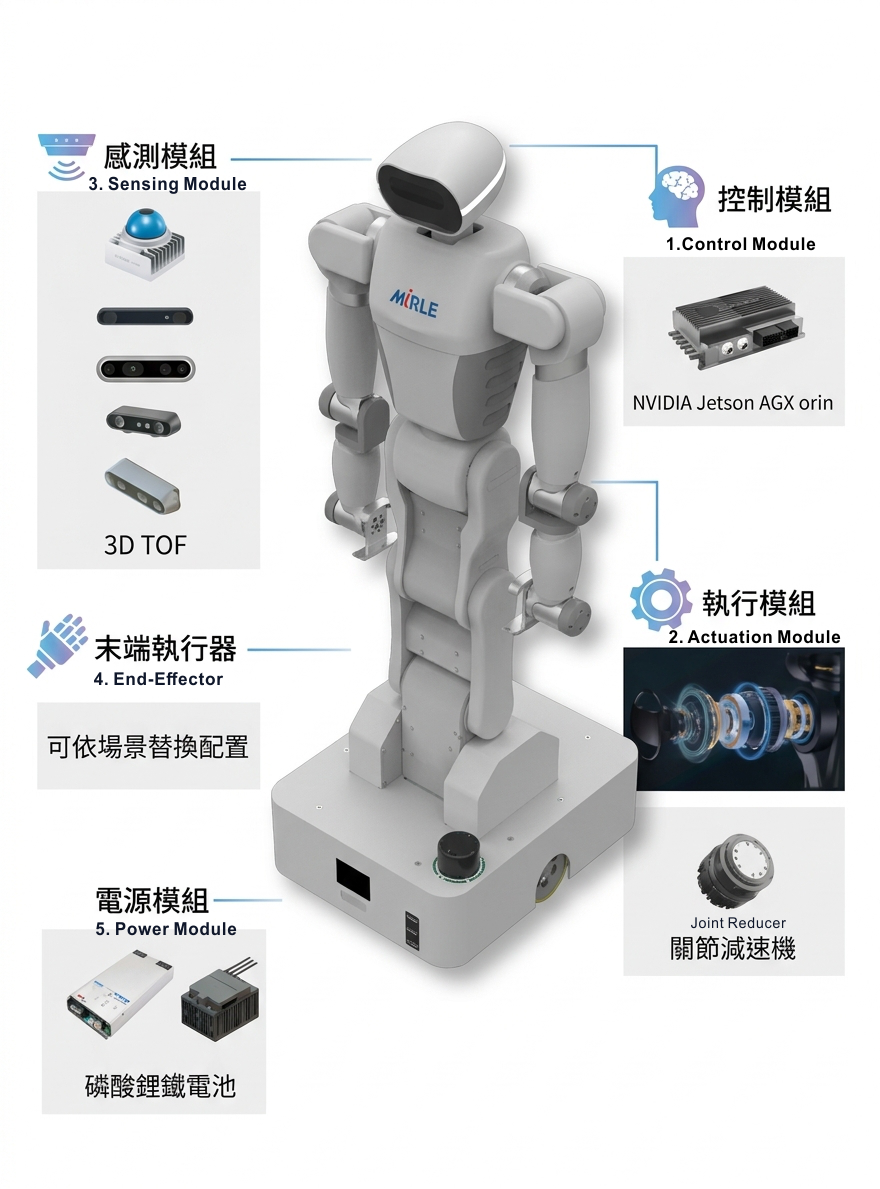
1.Control Module: NVIDIA Jetson AGX Orin, serving as the robot's main computing unit for AI processing and control tasks.
2.Sensor Module:3D LiDAR and RGB-D cameras equipped with multi-sensor 3D perception for environmental sensing and depth measurement.
3.Joint Drive Module:Includes joint reducers for precise motion control of robotic arms and body joints.
4.End effector: Gripper / Dexterous Hand. Configurable according to specific application scenarios and task requirements.
5.Power Module:Integrated LiFePO4 battery pack and Battery Management System (BMS), supplying reliable power to the chassis and articulated limbs.
In terms of application positioning, Mirle's AI Humanoid Robot is equipped with autonomous mobility and uses its dual arms to perform operational tasks such as pick-and-place, machine loading/unloading, workpiece transfer, and assistive assembly. This allows the robot to participate directly in production processes beyond basic transport or patrol duties, functioning as a flexible automation unit combining mobility and manipulation for semiconductor manufacturing environments.
To meet the high standards for stability and reliability in semiconductor manufacturing, Mirle's AI Humanoid Robot emphasizes smooth operation and accurate positioning during movement control, motion planning, and manipulation. This reduces potential micro-vibration impacts on equipment and processes while allowing deployment along existing fab pathways and operating standards to shorten integration and validation timelines.
In practice, the platform is suitable for multi-station operations, cross-process support, and high-frequency repetitive tasks, supporting high-mix flexible production and helping maintain operational stability under labor constraints. Grounded in a design philosophy of "Stability First, Practicality-Driven," the platform focuses on semiconductor and high-precision manufacturing needs as a practical step toward industrial deployment.
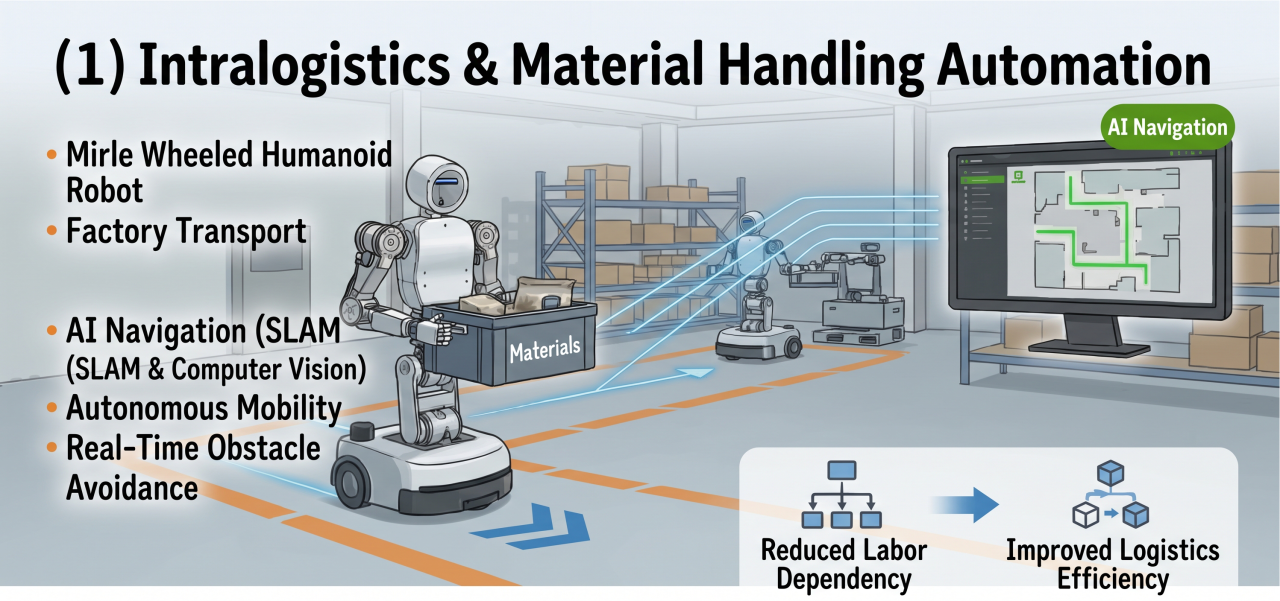
(1)Intralogistics & Material Handling Automation
a. Mirle's wheeled AI humanoid robot can execute material and component transport tasks in factory environments, helping reduce labor dependency and improve internal logistics efficiency.
b. Through integrated AI navigation technologies (SLAM and visual recognition), the robot navigates complex factory settings autonomously with real-time obstacle avoidance, dynamically adjusting paths according to production workflows to meet flexible logistics needs.
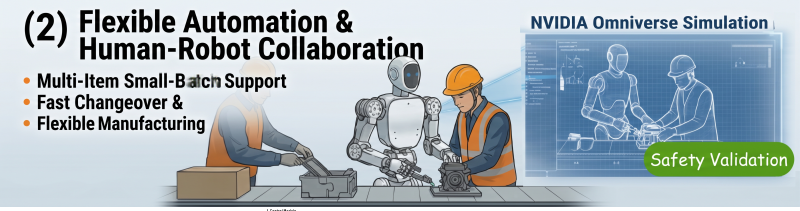
(2)Flexible Automation & Human-Robot Collaboration
a. The platform adapts to different production line layouts and process requirements, supporting multi-item, small-batch manufacturing with quick line changeovers and flexible production modes.
b. Using the NVIDIA Omniverse™ platform for human-robot collaboration simulation, safe interactions between humanoid robots and operators can be validated in virtual environments for assembly and packaging tasks, reducing deployment risks.
c. Combined with AI learning techniques, the robot can gradually learn human operating procedures to assist with highly repetitive and labor-intensive tasks, improving overall production stability and flexibility.
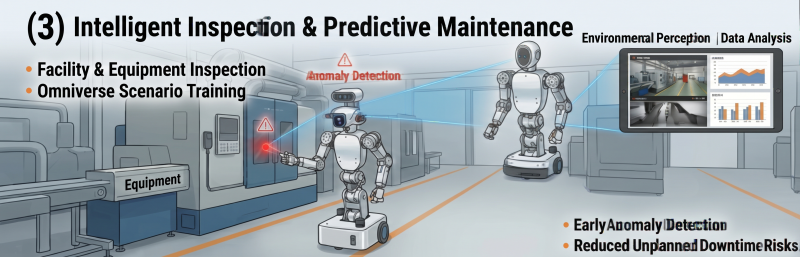
(3)Intelligent Inspection & Predictive Maintenance
a. Mirle's inspection humanoid robot can be applied to factory equipment and environmental inspection tasks, using Omniverse for scenario training and anomaly simulation to improve identification accuracy for equipment anomalies and environmental risks.
b.Through sensor fusion, environmental perception, and data analysis, the inspection robot can help detect potential anomalies early, enhancing operational safety, reducing unplanned downtime risks, and lowering overall maintenance costs.。
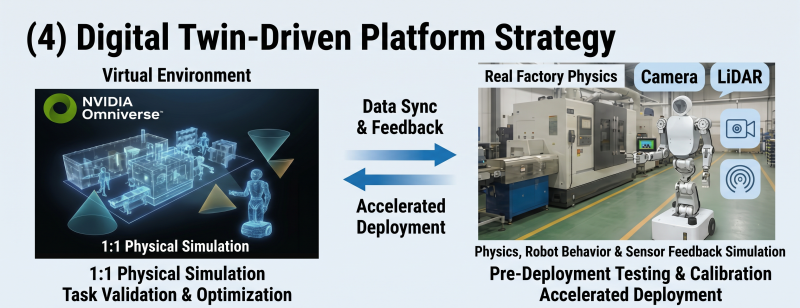
(4) Digital Twin-Driven Platform Strategy
a. Mirle leverages NVIDIA Omniverse™ Digital Twin technology to simulate real factory physical conditions, humanoid robot behaviors, and sensor feedback (such as cameras and LiDAR) in virtual environments for task validation and system optimization.
b. Humanoid robots can undergo thorough testing and calibration prior to deployment, reducing on-site trial-and-error costs, accelerating deployment timelines, and making smart factory automation systems more efficient, flexible, and scalable.
Careers
MIRLE has a variety of positions available,both technical and non-technical for talented professionals at all experience levels.
Please Enable cookies to improve your user experience
We use cookies to improve your user experience and for web traffic statistics purposes. By continuing to use this website, you agree to our use of cookies. Our Privacy & Cookie Policy contains more information.